Showing posts with label Resolve Strategic. Show all posts

Friday, April 26, 2024

Has Resolve Strategic changed its polling methodology?

The aggregation models I use make many simplifying assumptions. One assumption is that the polling methodology adopted by each polling firm remains unchanged over time. If a pollster indicates that they have changed their polling methodology, then I would treat the subsequent polls as a different series to the prior polls. I have done this with Essential when they published a change to their polling methodology.

When I look at the recent polls from Resolve Strategic, it looks like the polls from 2024 are less favourable to Labour than the polls from the prior two years. In the first chart below, we can see that the last poll result was almost four percentage points more favourable to the Coalition than the long term average for Resolve Strategic. In the second chart below, we can see that historically Resolve Strategic has been the most favourable poll for Labor (on average). And in the third chart below, we can see that the individual Resolve Strategic polls in 2022 and 2023 (indicated with the letter h) were often (but not always) well above the aggregation, and two of the three polls in 2024 are not. 


Now, this could be just the usual random noise and chance that comes with statistics. And in coming months we will see a return of the prior patterns of systemic house bias at Resolve Strategic. But this apparent change could also be the result of a change in polling methodology at Resolve Strategic. At the moment I don't know which explanation is the most plausible. While I have looked, I have not seen a statement on any methodology change from Resolve Strategic (please provide a link below in the comments if I have simply missed it).

If this apparent change in house bias is sustained in the next couple of Resolve Strategic polls, I will assume that there has been something of a change in polling methodology, and I will separate the 2024 and subsequent polls into their own series. 

Please note: this is not a criticism of Resolve Strategic. I have enormous respect for all pollsters, and I appreciate that opinion polling is much harder today than it was (say) 35 years ago (when almost every house had a landline and no-one had mobile phones). At the moment, I am just observing that the last three polls from Resolve Strategic perhaps look a little different from the earlier polls, and I am musing why this might be the case. Nonetheless, I would be somewhat disappointed if it turns out that Resolve Strategic has changed its polling methodology but has not communicated how it has changed and why it has changed.

Monday, November 13, 2023

Resolve strategic 57/43

The latest Resolve Strategic poll from 5 November has Labor with a two party preferred vote of 57 and the Coalition on 43. 

On my models, Resolve Strategic is around four percentage points more favourable to Labor than the average for all pollsters across the time-series of opinion polls. The first model is the Gaussian Random Walk [GRW] with house effects that sum to zero. [The "Normal" in the header is because I used a Normal likelihood distribution for fitting the underlying random walk to the polling observations. The "fixed" refers to the fact I used selected fixed value priors rather than let the model settle these.]


The second model is a Gaussian Process [GP], again with House effects that sum to zero. 


Thursday, January 20, 2022

Resolve Strategic - first poll for 2022

The January 11-15 Resolve Strategic (RS) poll was published in the Fairfax press on Tuesday this week. It was significant for two reasons:

  • Up until this poll, RS had been fairly supportive of the Coalition. This poll places it more in line with the other pollsters suggesting that Labor has a significant lead in the polls this election year.
  • It found very high support for the non-mainstream parties.

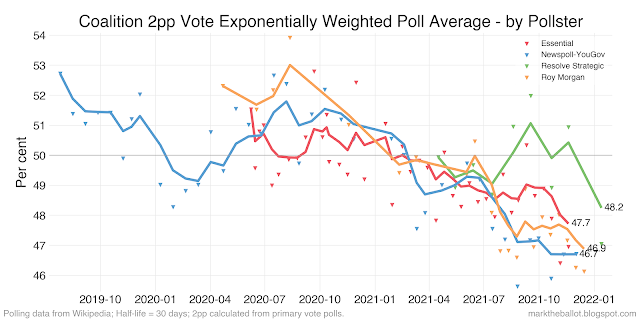
RS does not publish a two-party preferred estimate. Based on 2019 preference flows, I estimate this poll as 47-53 in Labor's favour. The next two charts aggregate the polls using an exponential weighted average with a 30 day half-life for the individual polls. After that I have my usual state-space model aggregation of the two-party preferred voting intention. This Bayesian model assumes that the voting intention on any day is much like the day before (i.e., it behaves like a Gaussian random walk), and that the individual systemic pollster biases sum to zero (or cancel each other out).


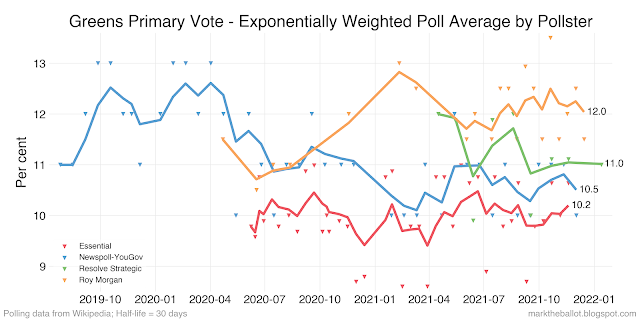
In terms of the primary votes, RS has a substantially higher other party vote than the other pollsters. It also has a much lower vote for Labor. RS is much closer to the other pollsters in terms of the Greens and somewhat closer with the Coalition. The stark differences between pollsters on the primary votes is something I find a little uncomfortable.


Updated primary vote poll aggregations follow.